

Image
The Maryland Center For History and Culture
610 Park Avenue
Baltimore , MD 21201

Connect with the American story at the Maryland Center for History and Culture. We invite you to ask questions, make discoveries, learn something new, and be inspired by the past as we look to the future.
We are a statewide resource headquartered in the heart of Baltimore’s Mount Vernon neighborhood cultural district. Our museum features more than 1,000 objects on display in 15 permanent and rotating exhibition galleries. Our library houses 7 million books, documents, manuscripts, and photographs available for research and scholarship.
Altogether, the Maryland Center for History and Culture houses one of the country’s largest collections of state heritage maintained by a private, nonprofit institution. Come see it for yourself.
The Unfinished Revolution
The American Revolutionary War was just the beginning. While sometimes called the American War of Independence, the effort to become a free and independent nation could not be so tidily confined. Emerging from seven years of warfare, the infant nation soon found itself trudging back into conflict. Over the next three decades, the new American ideals of free trade and republicanism had to be defended before they could take shape.
The Unfinished Revolution ties together the French and Indian War, the American Revolutionary War, the Quasi-War, and the War of 1812 as one connected narrative, exploring the effects these conflicts had on Maryland, and the political and economic growth of the state and the nation thereafter.
Throughout the exhibition, the concept of independence is continually dissected. What did independence mean with each passing conflict, each treaty, and to whom did it apply? Alongside the stories of the war heroes, immortalized in portraiture, are those of everyday men turned into soldiers, Black and white, free and enslaved, who may only be represented in extant archival material. The Unfinished Revolution also includes how the conflicts affected those who didn’t fight, of enslaved women who fled with the British Army to a new life in Canada, and of women known as “camp followers” who followed their husbands to war because they had no provisions or support at their homes.
The Unfinished Revolution opens in the museum gallery that previously featured In Full Glory Reflected: Maryland in the War of 1812, a popular and award-winning exhibition that was installed in 2012 for the nation’s bicentennial anniversary. Now, The Unfinished Revolution opens as the United States looks ahead to its 250th anniversary in 2026.
Doohoregan Manor Account Book – Six pages from this book on display lists the names, ages, and family units of 330 enslaved men, women, and children on one day in 1773 at Doohoregan Manor (also known as “Doughoregan”), the home of Charles Carroll, one of the colony’s largest landowner, enslaver, and a signer of the Declaration of Independence from Maryland. The document highlights the disparity at the start of the American Revolution by those calling for their independence and freedom and those trapped by the bonds of enslavement.
The Yankee Tar – On display for the first time will be John Hoxse’s book, The Yankee Tar: An Authentic Narrative of the Voyages and Hardships of John Hoxse and the Cruises of the U.S. Frigate Constellation and Her Engagements with the French Frigates Le Insurgente and Le Vengeance. First written in 1840, the memoir traces Hoxse’s life as a sailor serving on various vessels from slave trade ships to the United States Frigate Constellation, and details horrific moments, such as having his arm detached in conflict. Hoxse served on the Constellation during the Quasi-War with France.
Chair from Henry Fite’s house – This object represents a special moment for Maryland in the Revolutionary War—the day Baltimore served as the capital for the United States. In December 1776, with the British Army on the shores of the Delaware River, Congress fled Philadelphia and moved to Baltimore. On December 20, they met at Henry Fite’s house in Baltimore, making the city the second capital of the United States.
1759 Powder Horn used by Jonas Green (1712-1767) – This object, from the period, may have been used in the French and Indian War. Green was the printer of the Province of Maryland, publisher of the Maryland Gazette, and a fierce opponent of the Stamp Act.
Bullet that wounded the hand of Jesse Levering – Levering was a merchant from Baltimore and fought at the Battle of Bladensburg in 1814.
Support for this exhibition is generously provided by The Society of the Sons of the Revolution in the State of Maryland, The General Society, Sons of the Revolution, and The Society of the Cincinnati of Maryland.

Group Tours
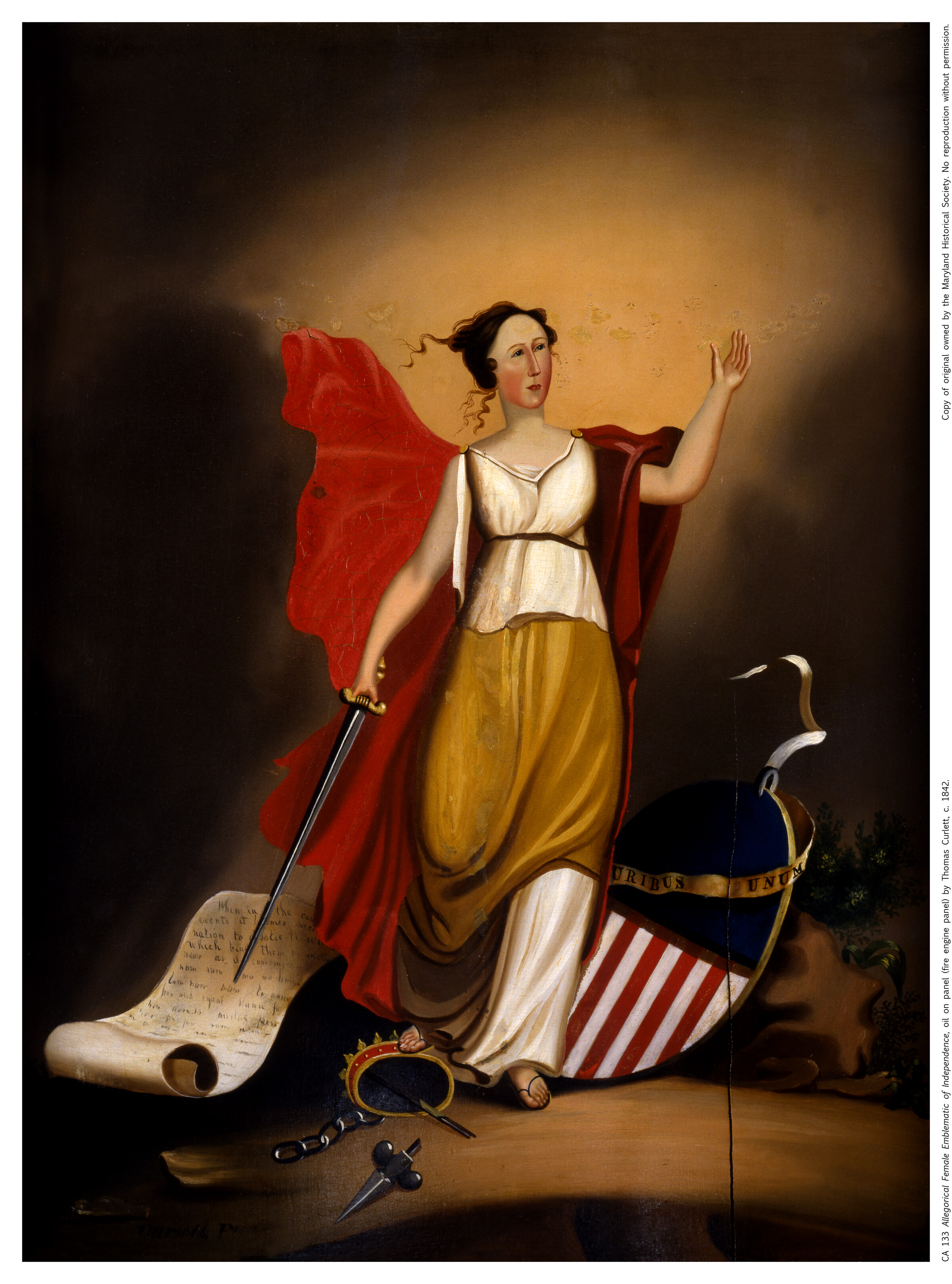
Thomas Curlett (circa 1842)
View Details about Allegorical Female Emblematic of Independence

Carroll family (1773-12)

unknown (circa 1785-1805)

Sunny, with a high of 68 and low of 46 degrees. Sunny in the morning, clear in the afternoon and evening,