


Image

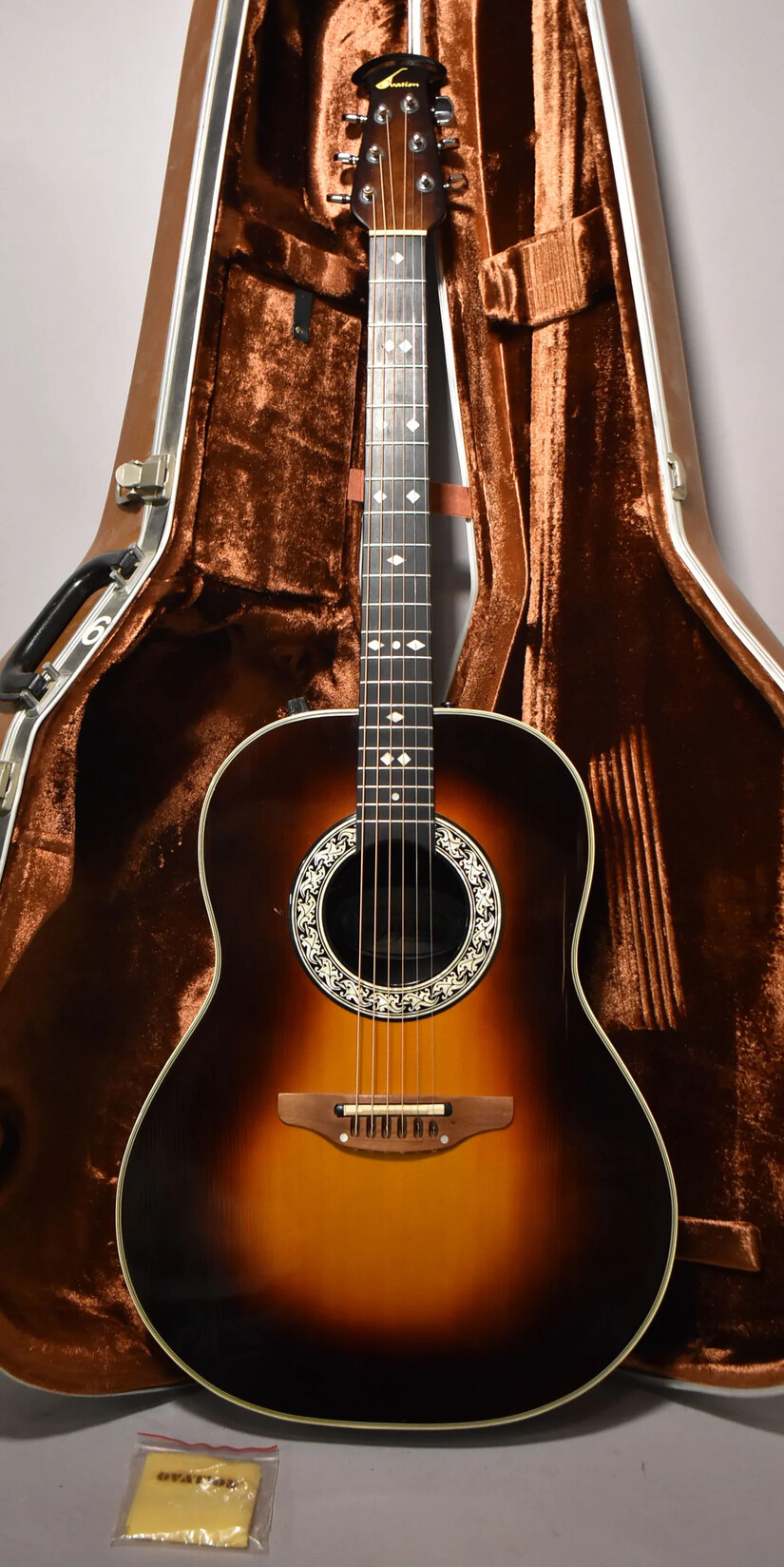
Ovation Guitars is celebrated for revolutionizing the acoustic guitar, and it is celebrating its 60th year. The brand pioneered the first productions round-back acoustic and introduced the first commercial piezoelectric pickup and preamp system, making them the first acoustic instruments specifically designed to plug directly into an amplifier or sound system for live performances
Ovation guitars are differentiated by their composite synthetic bowl, rather than the traditional wooden back and sides of the modern acoustic guitar as produced by luthiers starting in the late 18th century. Ovation has also produced solid body electric guitars and active basses.
Developed starting in 1966 and introduced as the 'Balladeer' in February, 1967, Ovations reached the height of their popularity in the 1980s, where they were more often than not seen during live performances by touring artists if acoustic guitars were being played. Ovation guitars' synthetic bowl and early use (1971) of preamps, onboard equalization and piezo pickups were particularly attractive to live acoustic musicians who constantly battled feedback problems from the high volumes needed in live venues.
NEW HARTFORD, CONNECTICUT
On the banks of the Farmington River in new Hartford, Connecticut, there’s an old New England brick building that was home to Ovation Instruments and of course, the original acoustic roundback guitars.
Ovation was a subsidiary of the Kaman Corporation, an aerospace company employing more than 2,700 employees, with 25% of them being scientists, engineers and technicians. Charles Kaman, the president and a guitar enthusiast, decided that his company could apply its technology to the age-old art of guitar making.
In 1966, after 18 months of testing and research, the Kaman engineers concluded that the most efficient shape for a guitar back is semi-parabolic. The sound such a shape produced from any given energy input was, they found, measurably richer, fuller, deeper and more constant from top to bottom of the scale.
Having made this determination as to shape, the engineers next undertook to find a better material. Since the early Crusades, flat-backed, straight-sided guitars have been made of wood. But the Kaman people felt that even the best woods had serious limitations.
Among the limitations:
Wood is difficult if not impossible to contour to the new round shape. It would require the use of internal bracing and reinforcing members, and, as in conventional guitars, these members would act as baffles, substantially dampening and absorbing the sounds, and setting up non-repetitive vibration patterns which the human ear hears as noise. A guitar top must vibrate to help amplify tone. To vibrate properly, it must be extremely thin and thin wood is, of course, fragile. Sound, like light, reflects best from a smooth surface, and wood is porous. The cellular structure of wood and the natural oils in it vary considerably, not only from one guitar to another, but within a single instrument. The varying densities thus created make it extremely difficult to achieve consistent vibrating characteristics.

To develop a material free of such characteristic disadvantages, Kaman’s engineers first made acoustical studies of many of the exceedingly strong yet lightweight laminar substances they had perfected for use in aircraft rotors, fairings, radomes, missile nose cones and other aerospace components often exposed to high vibrational stress. Encouraged by what they found in these studies, and using them as a base, they then developed and tested many new materials.
Finally they found one, the molecular structure of which actually could be “tuned” (chemically and by heat treating) to a precise degree of resonance.WE CALL IT LYRACHORD






Lyrachord is still the material we use today, to create these truly remarkable instruments. Listen for yourself. Hear the rounder, fuller, totally unique sound of the Ovation Roundback. Let your own ear confirm the difference that aerospace technology has created. We think you’ll agree, you’ve never heard it so good!



Sunny, with a high of 69 and low of 53 degrees. Sunny in the morning, clear in the afternoon and evening, overcast overnight.