49° and Mist



Image
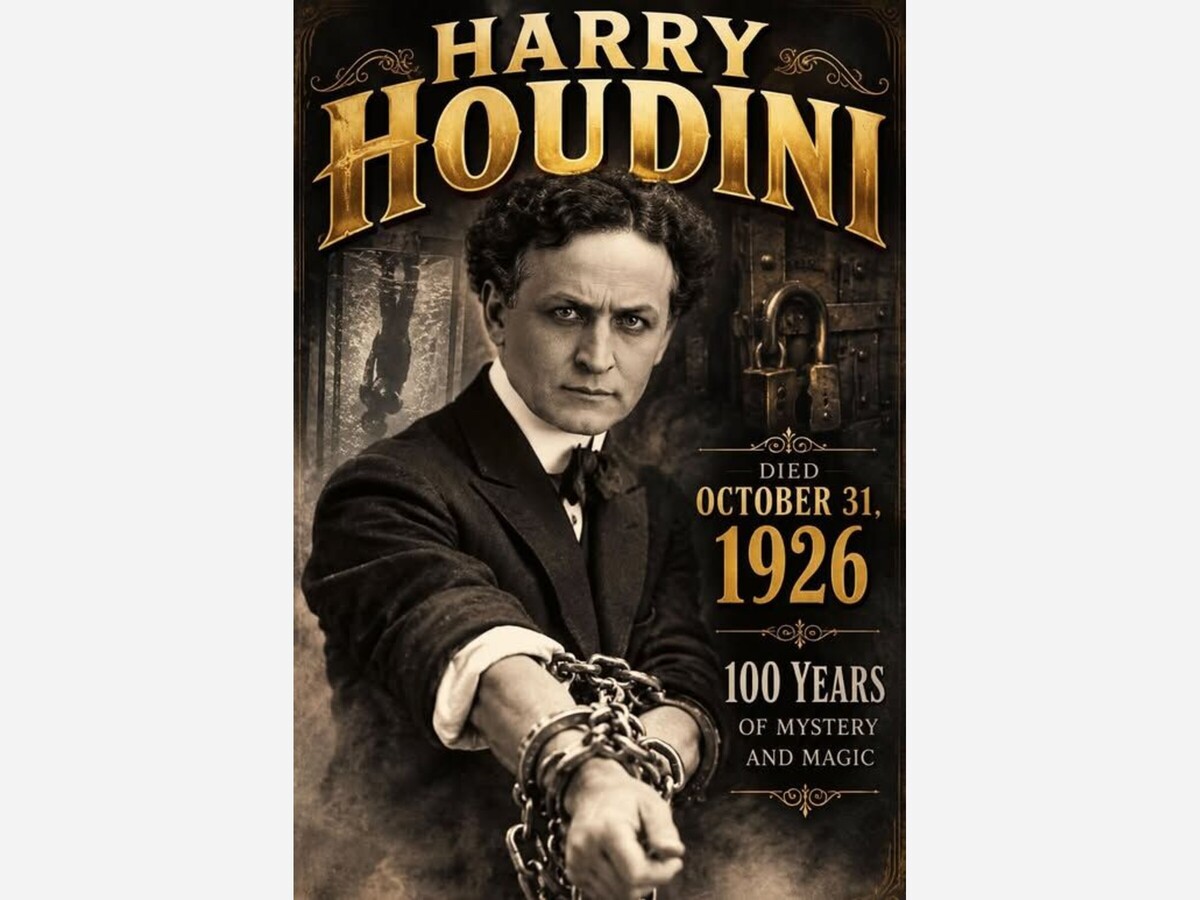
Harry Houdini is punched nine days before his death
On October 22, 1926, legendary escape artist Harry Houdini is repeatedly punched in the abdomen by a university student testing the magician’s claim that he could withstand any blow. Nine days later, Houdini dies on Halloween from complications of a ruptured appendix, sparking a lasting debate over the cause of his death.
Canadian student J. Gordon Whitehead, accompanied by two other students, visited Houdini’s dressing room at Montreal’s Princess Theatre. Houdini reportedly agreed to be punched and allowed Whitehead to hit him extremely hard in his lower right abdomen several times while the magician lay on a divan.
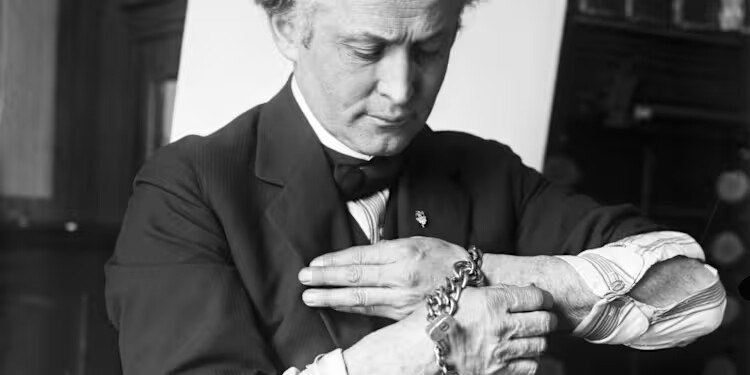
The students noted that the escape artist, known for jaw-dropping stunts, seemed to be in terrible pain. But Houdini was determined to go on with the show. After performing the following evening, he traveled to Detroit, where he sent a telegram requesting medical attention. Despite a high fever and pain, he took the stage on October 24 for what would be his final performance.
After the show, he was hospitalized and diagnosed with appendicitis. During surgery, doctors discovered a burst appendix and an abdominal cavity full of pus. A few days later, a second operation failed to stop the infection. In an era before antibiotics were widely available, his condition continued to deteriorate.
Houdini, born Erik Weisz, died on October 31, 1926, at age 52. Although the timing fueled speculation that the punches had caused his appendix to rupture, medical experts have questioned that connection. It is possible he was already suffering from appendicitis.
Houdini was buried at Machpelah Cemetery in Queens, New York, where his grave continues to attract visitors, especially around Halloween.
Houdini Comes to Town
 Downtown Near The Sunpapers Building
The Magic in Baltimore Police History
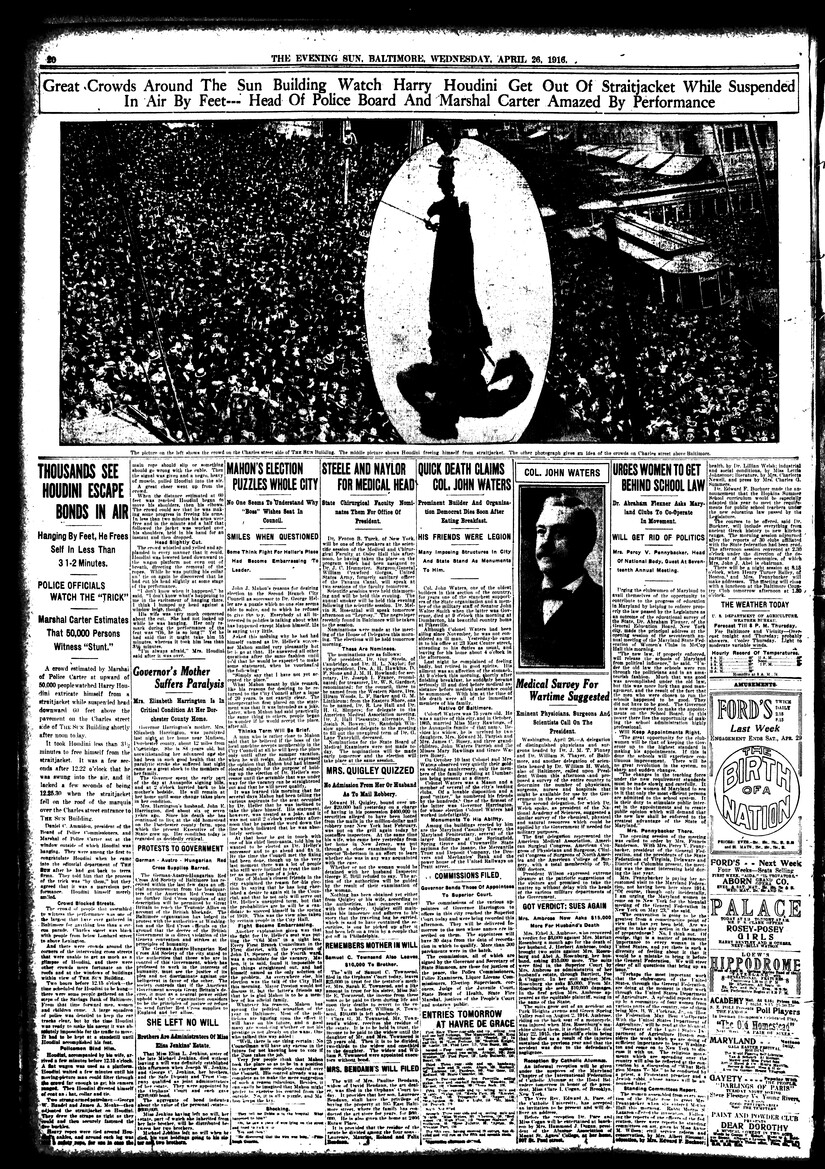
On 26 April 1916 no less than 50,000 men, women and children jammed shoulder to shoulder in downtown Baltimore to see Harry Houdini the famous escape artist, give the greatest free show that up until that time the city had never seen.
In front of the old Sun Paper Building at Baltimore and Charles Streets was a block and tackle which extended down to a platform on the sidewalk facing the Savings Bank of Baltimore. The short stocky magician stripped off his coat and dropped to a sitting position on the platform, his assistants James Collins and James Victory swiftly went to put padding around his ankles, applying a brace to his ankles that would be attached to the rope of the block and tackle above.
Then our Baltimore Police ancestors Patrolmen George W. Baudel and James a. Moncks both of which were trained in the use of the restraint having worked the cell block, pulled their jacket a regulation Baltimore Police Straight jacket tight behind the Houdini’s back, tugging to fasten the leather straps as securely as they possibly could.
They then placed his sheathed arms across his chest and again yanked and tugged until the thongs at the closed end of the sleeves were buckled tightly to the rear of the straitjacket and the final strap going from front to back between the performer's legs preventing him from simply slipping the jacket over his head were put into place and secured.
Soon he was being hoisted, head downwards, high above the streets of Baltimore. When he was approximately 50 feet in the air an official timekeeper from the Sun Paper gave a signal and the struggle the crowd had come to see began. Houdini squirmed and twisted in the air like a wicket tuna at the end of a fishing line.
His face became red then redder by the moment as his blood rushed to its head. Every 5 seconds the man with a stopwatch shouted the time, “50-seconds – 55-seconds – 1 minute, by the 1.5-minute mark one of his arms had freed its buckle. That brought cheers, his other arm was wrenched three at 1:55. Another minute he had begun to slip the jacket from his body, 30 seconds later the canvas and leather police restraint was seen to plummet from 50 feet in the air, down into the crowd below.
A mighty roar came from the crowd greeting his success; the master showman smiled and extended his arms, taking his bow while still upside down... and still hanging 50 feet in the air.
For Houdini fans, it might be interesting to know that Houdini performed often in Baltimore. So while it is not as fascinating as the upside-down escape jacket, But still interesting; in the Tony Curtis movie, reflecting the life and time of harry Houdini, we see Bess, Harry’s wife angry because she didn’t want him doing the “Chinese Water Torture Cell” and made it seem as if the first time he had done the trick it took his life.
Truth be told, while in Baltimore many years earlier Harry performed what he described as his most strenuous performance ever. At each performance, he would be locked upside down in a water-filled “Chinese Water Torture Cell” and freed himself every time, a trick he had performed for many many years going back to 1916 right here in Good ole Baltimore.
Houdini Returns to Hollywood on Halloween for Centennial Auction of 100 Rare Artifacts
A century after the legendary escape artist’s death, a collection of personal items and memorabilia reveals the man behind the magic. Online bidding open to all
Even 100 years after his death, Houdini remains synonymous with magic. These deeply personal objects offer a rare glimpse into his life, making this centennial auction truly extraordinary.”— Gabe Fajuri, President, Potter & Potter Auctions
Exactly 100 years after Harry Houdini’s death on Halloween 1926, 100 rare artifacts from the legendary magician’s life will go up for auction at the Magic Castle in Hollywood on Saturday, October 31. Presented by Chicago-based Potter & Potter Auctions, the centennial sale brings together objects that reveal not only Houdini’s extraordinary career as an escape artist, but also his early struggles, carefully cultivated celebrity, personal relationships and efforts to expose fraudulent spiritualists.
Assembled over decades by Houdini historian and collector Kevin Connolly, the collection includes photographs, correspondence, personal possessions, books, handcuffs and other memorabilia, including pieces rarely or never before seen publicly.
The Man Behind the Escapes
Long before Houdini became an international sensation, he was a struggling performer trying to make a living. Among the earliest objects in the collection is an 1898 booklet titled Magic Made Easy, which Houdini sold following performances in dime museums, circuses and vaudeville venues to supplement his income.
Other objects capture the extraordinary fame he eventually achieved.
An enormous theatrical lobby photograph shows Houdini wearing an overcoat and hat, with his name prominently displayed beneath the image. Created at considerable expense, the photograph contains no depiction of an escape, handcuffs or magic trick. By that stage in his career, Houdini’s face and name alone were enough to attract an audience, illustrating his remarkable understanding of celebrity and self-promotion.
Even seemingly ordinary objects reveal the meticulous thinking behind his performances. A set of handcuffs bears a tiny mark Houdini used to identify his own equipment, an inconspicuous detail that offers insight into the preparation behind his seemingly impossible escapes.
A Magician Who Challenged the Supernatural
Houdini’s fascination with spiritualism and his efforts to expose fraudulent mediums became an important part of his later life.
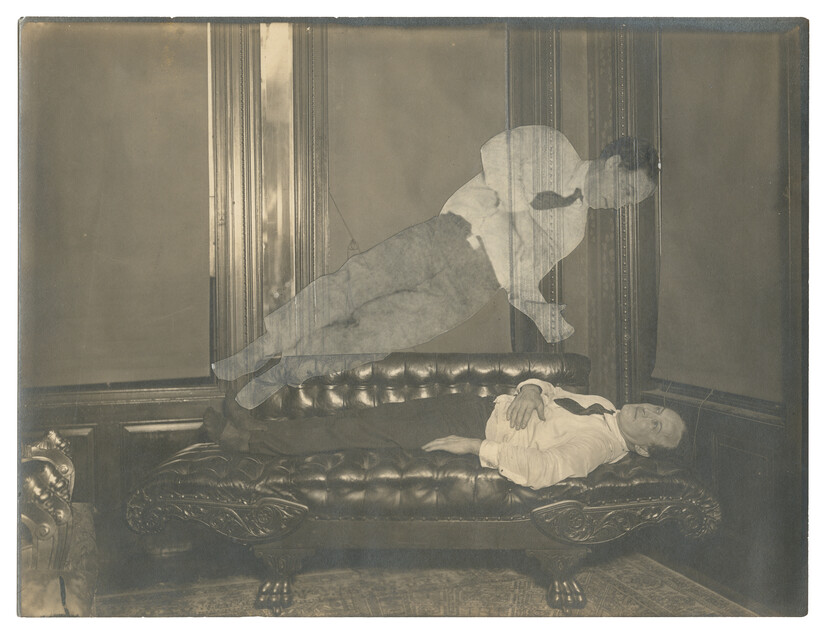
Among the collection’s most intriguing photographs is an image depicting Houdini’s ghost rising from his own body. Rather than evidence of the supernatural, the photograph was deliberately staged by Houdini to demonstrate how supposedly authentic spirit photography could be manufactured.
Another photograph captures Houdini in disguise, a tactic he employed while attending séances to investigate mediums who claimed to communicate with the dead.
The collection also includes a poignant reminder of the enduring fascination with Houdini after his death: an invitation to the final séance held by his wife, Bess, in Los Angeles on Halloween 1936. Ten years after losing her husband, and following years of attempts to contact him through the spirit world, Bess ended her annual efforts to reach him.
Other personal objects offer a more intimate perspective, including a pocket watch presented to Houdini by Bess following his historic flight in Australia, bearing an inscription with a private code.
A Hollywood Auction Open to Bidders Around the World
The collection was exhibited throughout October at Potter & Potter Auctions’ Chicago gallery before traveling to Los Angeles for the centennial sale.
An invitation-only preview will take place on Friday, October 30, ahead of the auction at the Magic Castle on Saturday, October 31.
Although in-person attendance at the auction is restricted to Magic Castle members, bidding is open to the public online, allowing collectors, magic enthusiasts and Houdini admirers anywhere in the world to participate. Interested bidders can explore the collection and register to bid through the auction’s online catalog.


Overcast, with a high of 63 and low of 48 degrees. Overcast in the morning, mist overnight.