

Image
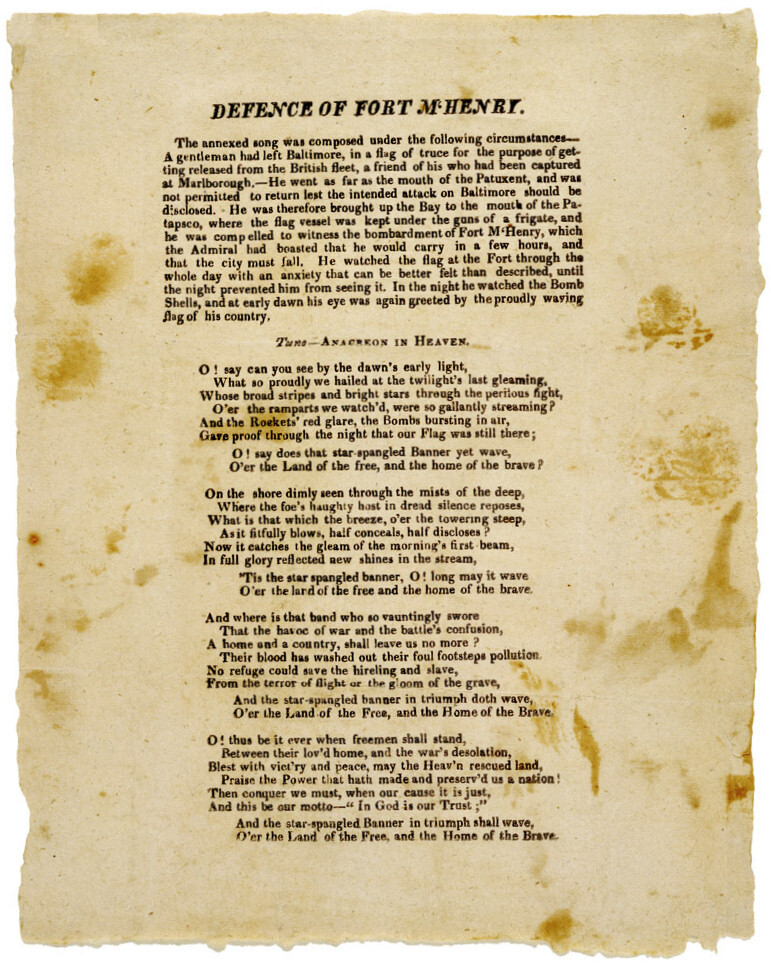
Birth of The Star-Spangled Banner: In 1814, its (The News American's)predecessor, the American & Commercial Advertiser, became the first publication in the nation to print Francis Scott Key's poem, "The Defence of Fort McHenry," which later became known as The Star-Spangled Banner.
Exactly forty years ago my University of Maryland internship was at the News American. That semester coincided with the final months of the paper, I was to find. I interviewed for, edited, compiled and wrote many published articles at the features desk downtown.
The atmosphere in the entire news building and newsroom was depressing. Reporters and office people, columnists I recall, hardly mustered a smile. Their life-long careers were at a crossroads.
I re-evaluated if I wanted to stay in journalism, especially on a daily. I chose not to, mainly based on this experience. Newspapers were dying. Baltimore was no longer a 2, or 3 daily town. Dailies were dropping daily. I still wrote news articles for the UM daily Diamondback.
Later I wrote for weeklies and magazines for a few years, then dabbled in writing on the side (songwriting, poetry, prose, memoir) until partnering with Patch to create Hunt Valley Life, also this very week, in 2021.
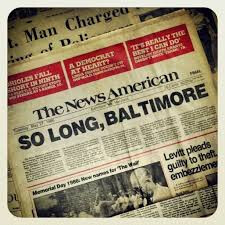
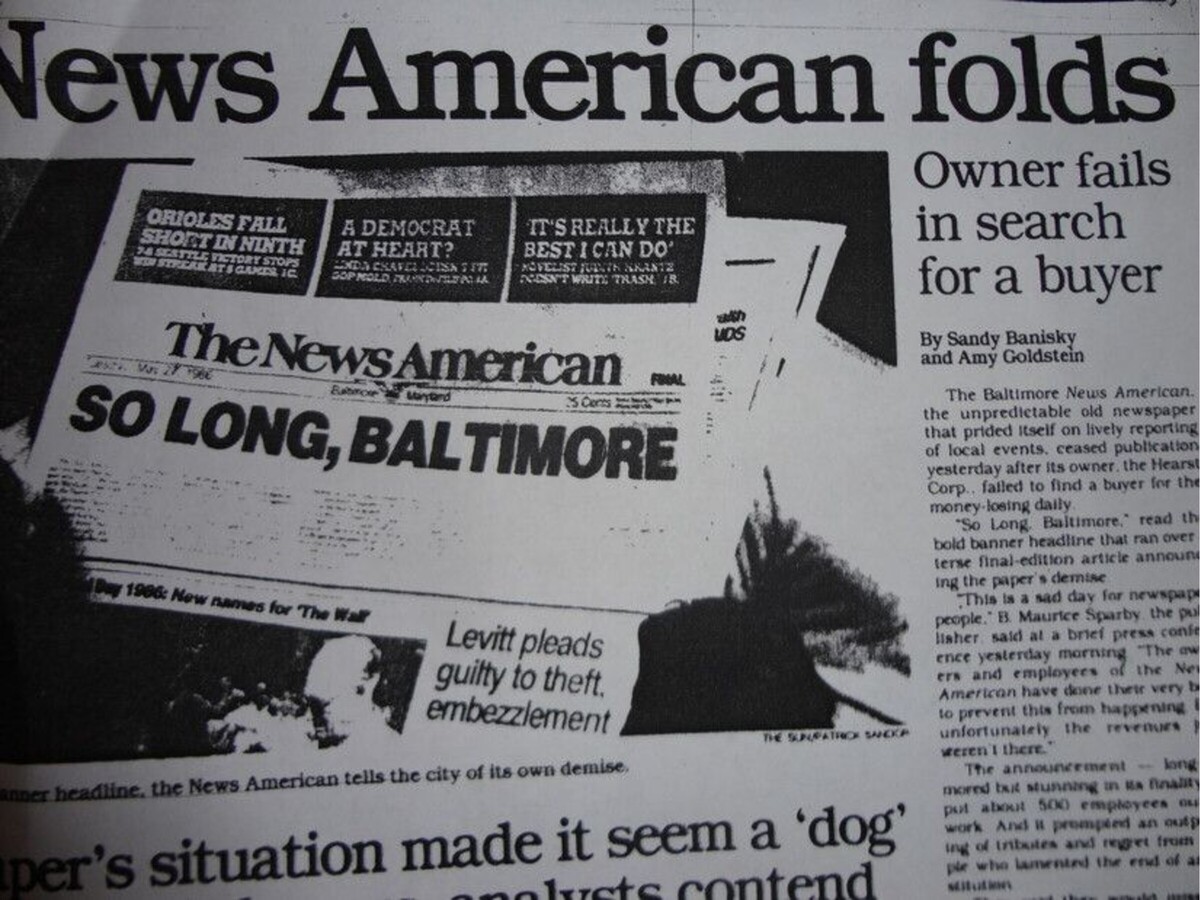
The Baltimore News-American was a daily newspaper that traced its lineage back to 1773. It was long known as an afternoon publication focused on working-class and blue-collar districts. After publishing its final edition on May 27, 1986, the paper officially ceased operations
_(cropped).png) Drawing of the Baltimore American Building in 1914 publication
Drawing of the Baltimore American Building in 1914 publicationThe entity known as the News American was formed by a final merger of two papers, the Baltimore News-Post and The Baltimore Sunday American, in 1964, after a 191-year history and weaning process. Those newspapers each had a long history before the merger, in particular the Baltimore American which could trace its lineage unbroken to at least 1796, and, traditionally, it claimed even earlier antecedents to 1773. Other precursor newspapers The News and the Baltimore Post were founded in 1873 and 1922, respectively, and broke new ground in graphics, technology, journalistic style, and quality of writing and reporting.
The Newspaper
The News American was a daily newspaper in Baltimore, Maryland, which possibly had a continuous existence in print form for 214 years. Its editors and writers produced notable stories and helped make events more vivid and immediate for readers. For example, in 1814, the American & Commercial Advertiser became the first publication in the nation to print Francis Scott Key's poem "The Defence of Fort McHenry," which later became known as The Star Spangled Banner. In 1923, one of the most influential owners in the history of the newspaper, William Randolph Hearst, Sr., bought several of the News American's predecessor papers. Under the management of the Hearst family, the News American became the largest newspaper in Baltimore in terms of circulation by the middle of the twentieth century. On May 27, 1986, the News American published its last edition and shuttered its operations.
During its over 200 year existence, the News American experienced a number of transformations in its management, many of which were the result of business mergers. According to some historians and former employees of the newspaper, the News American traces its lineage back to Baltimore's first newspaper, the Maryland Journal and the Baltimore Advertiser, begun by William Goddard on August 20, 1773. Under the leadership of William Goddard's sister, Mary Katherine Goddard, the newspaper was the first to print the Declaration of Independence with the names of its signatories. Goddard's newspaper passed through several proprietors and ultimately ceased publication on June 29, 1797.
A competing argument suggests that the true originator of the News American newspaper may actually have been Alexander Martin, who likely began a new publication called the American and Daily Advertiser on May 14, 1799. Martin was a former partner of William Pechin, who once wrote for the old Maryland Journal. A partisan Republican-Democratic paper at that time, the American and Daily Advertiser was subscribed by Thomas Jefferson, who had a two-year subscription beginning March 24, 1801, during his term as President (see Founders Online, Thomas Jefferson, "List of Newspapers [circa April 23, 1802]").
Some other notable newspaper titles in the history of the newspaper include the Baltimore American and Commercial Advertiser (1857-1861) which was sometimes published under the title of the Baltimore American, the American and Commercial Advertiser (January 1-August 1858) and the American and Commercial Advertiser (1862-1869). Under the leadership of Charles Carroll Fulton, these newspaper titles were among the few major Baltimore newspapers to be pro-Union during the American Civil War. Other important nineteenth century predecessors to the News American newspapers were: General Felix Angus's Baltimore American (1883), Edmond V. Hermanage's Evening News (1872) which was Baltimore's first successful evening newspaper, and Charles H. Grasty's progressive Baltimore News (1892), where H. L. Mencken, the well-known Sun journalist, briefly worked as an editor.
During the late nineteenth century, a rivalry between the News American and the Sun began, one that would help to shape the history of Baltimore journalism into the 20th century. The Sun, while having a strong readership among the general masses, also increasingly gained a reputation as the newspaper of choice for Baltimore's elites. In contrast, the News American, and its predecessors beginning with the Baltimore News, began to be viewed, first as a progressive newspaper, and later, as a populist paper, which resonated with Baltimore's working-class and ethnic minorities.
In 1908, Frank A. Munsey bought the evening Baltimore News from General Felix Angus, and in 1920 Munsey purchased the morning Baltimore American. Three years later, Munsey decided to sell both papers to newspaper magnate William Randolph Hearst, Sr., who helped to introduce tabloid journalism and sensational headlines to readers in Baltimore. During the 1920s, the newspaper published many stories about crime and violence, and emphasized visual elements such as photographs and attention-grabbing headlines in large fonts. In 1928, the Baltimore American was discontinued as a morning newspaper, but the name was continued as a Sunday newspaper. Also in 1928, the Baltimore News gained the circulation lead over the rival Sun papers, which it held until the decline of the American beginning in the late 1970's.
In 1934, the Hearst Corporation bought the Baltimore Post from the Scripps-Howard Newspaper Syndicate, to form the Baltimore News and the Baltimore Post. In 1936, the company merged the two titles to form the Baltimore News-Post. The last newspaper title change in the history of the News American occurred on January 13, 1964, when the Baltimore News-Post and its Sunday edition, the Baltimore American, merged to form the News American.
For most of the 1970's, the News American continued to lead the Sun in circulation. In addition, in 1973 the newspaper reached a major milestone and celebrated its bicentennial anniversary. But the 1970's also signaled the beginning of the end for the News American. A number of social and economic factors, such as the rise of television, a demographic shift of Baltimoreans from the city to the suburbs, Baltimore's stagnant economy, and the loss of blue-collar manufacturing jobs contributed to the News American's demise. These issues, combined with the decline of evening newspapers in most U.S. markets, and internal management and labor related problems at the newspaper, effectively doomed the News American. During the 1980's, the difficulties facing the News American intensified and the Hearst Corporation, unable to find a buyer, decided to stop printing the newspaper. On May 27, 1986, the newspaper was closed for business.
The Buildings
The antecedent newspapers found in this collection were printed in a variety of locations, but always in Baltimore proper. Between 1849 and 1875, the Baltimore American was located at Nos. 126 and 128 West Baltimore Street. That latter year, a new iron building was constructed to house the American at Baltimore and Fourth Streets. Moving in 1905 to Baltimore and South Street, the new Baltimore American building occupied the site of a building destroyed in the great fire of 1904.
Beginning in the 1870s, the Baltimore News was published from a building at 119-121 East Baltimore Street until it moved to Calvert and Fayette streets around 1905. Five years later, the Baltimore News vacated that space and soon re-occupied it within the new Munsey Building, named after its owner-publisher Frank A. Munsey.
It was inside the Munsey Building on Calvert Street in 1920, where the American merged with Munsey's News. Upon Hearst's purchase of both papers from Munsey in 1923, the joint newspapers moved to Pratt and Commerce streets in 1924. On September 8, 1962, the Baltimore News-Post/News American moved into a new building at 400 East Pratt Street (bounded also by Commerce, Lombard, and South streets), presumably the location where the large advertising eagle (series 9) was hung. This complex of buildings contained the News American offices and printing presses. It was demolished partly by wrecking ball in 1990. (See series IV, boxes 2 and 4, for more information.)

Sunny, with a high of 68 and low of 53 degrees. Sunny in the morning, clear in the afternoon and evening, overcast overnight.