57° and Clear



Image
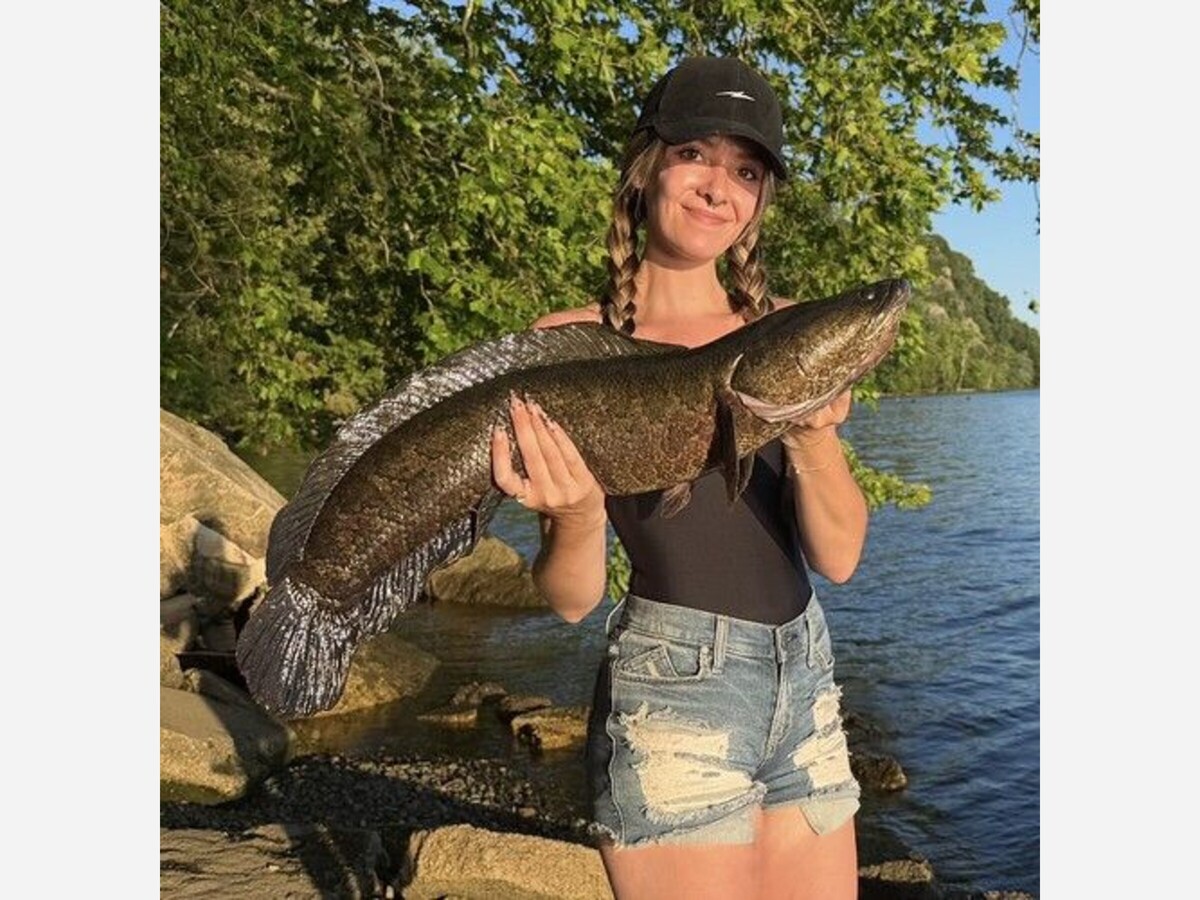

Master Angler Lucy Moore caught this large Chesapeake Channa, aka snakehead, recently in the lower Susquehanna River. Photo by Nick Perez
Families across Maryland are enjoying the outdoors together this summer and fishing is always a major part of spending time with children. Many youngsters will catch their first fish, and we hope fishing will be a big part of their lives in the future.
Read about the Hunt Valley Bear's Loch Raven adventure!

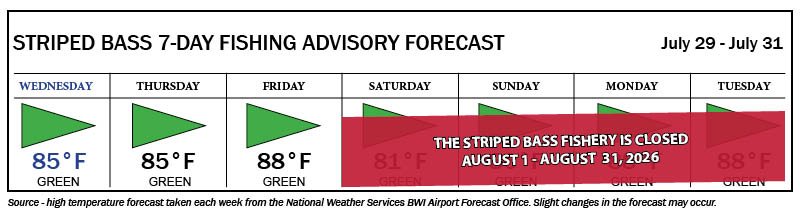
Beginning Saturday August 1, the Maryland Chesapeake Bay striped bass season will close through August 31 for conservation reasons. It will reopen on September 1. The tidal Potomac is also closed as of July 7 and will not reopen until August 21. The striped bass season along the coastal waters of Maryland will remain open. During this time we encourage anglers to explore the multitude of other species in our state.
One hundred lucky people were randomly selected to win a free blue catfish charter/guided experience this August, in our first-ever Reel in the Blues Bonanza. The winners have been notified by email. Even those who did not win this year can participate in the effort to remove invasive blue catfish from Maryland waters. Visit the blue catfish page on the DNR website to learn fishing tips, find a charter or guide to book your own trip, or buy blue catfish in restaurants or to make at home.
Forecast Summary: July 29 – August 4
Main Bay surface and river mouth water temperatures are holding in the low 80s and will likely continue to remain stable all week. Temperatures in smaller rivers and streams have cooled to the upper 70s. With recent storms, bottom oxygen levels should be improving throughout the week. Currently there is adequate oxygen in most Bay bottom waters except near Indian Head to the Colonial Beach (Potomac River) and in the Bay from the Sassafras River down to the Patapasco River area.
Expect average flows for most Maryland rivers and streams. Expect average clarity for most Maryland portions of the Bay and rivers. To see the latest water clarity conditions on NOAA satellite maps, check Eyes on the Bay Satellite Maps. There will be above average tidal currents all week because of the full moon on July 29.
As always, the best fishing areas could be further refined by intersecting them with underwater points, hard bottom, drop-offs, and large schools of baitfish. For more detailed and up-to-date fishing conditions in your area of the bay, be sure to check out Eyes on the Bay’s Click Before You Cast.
Upper Chesapeake Bay

Journey Triplett chose a white perch that she caught while fishing with her dad in the Sassafras River. This is her first fish; we hope this is the start of a long fishing career. Photo by Todd Triplett
The Conowingo Dam continues to be on a typical summer evening power generation schedule this week. The cool waters are attracting striped bass, three species of catfish and Chesapeake Channa to the dam pool and lower Susquehanna River. The early morning hours offer the best opportunity to catch striped bass, and the catfish can be caught throughout the day. During the Bay striped bass fishing closure that runs from August 1 through August 31, anglers will need to pursue other species . Blue catfish are the primary target catfish species in the dam pool and river and can be found holding deep.
Chesapeake Channa, also known as northern snakeheads, are entertaining anglers in the upper sections of the region’s tidal rivers. Shallow grass beds are the most frequented areas for Chesapeake Channa. Soft frogs, chatterbaits. and buzzbaits cast over shallow grass is one of the best ways to target them
DNR staff along with the U.S. Fish and Wildlife Service completed tagging Chesapeake Channa as part of a cooperative study that examines harvest rates and movement of the fish in portions of the upper Chesapeake Bay. From spring 2025 through May 2026, more than 450 snakeheads were tagged in tributaries of the upper Bay including the Bush, Elk, Gunpowder, Sassafras, and Susquehanna rivers. Reporting a tag comes with a cash reward; Fish were tagged with either a blue “high reward” tag worth $200 or yellow tags worth $10. Anglers must harvest fish and report tags to the USFWS Maryland Fish and Wildlife Conservation Office by phone at 1-800-448-8322. Anglers may report tagged fish for rewards through December 2026.
Before the summer closure, anglers are reporting finding striped bass holding near Pooles Island, the Love Point rocks, and in some of the shallower waters of the Bay. Live-lining spot and small eels are a popular way to fish, jigging and casting paddletails is also a good way to fish. The best fishing success occurs during the early morning and late evening hours due to bright sun and warm water temperatures. Finding suitable dissolved oxygen at deeper depths continues to be a problem in some areas.
Spot can be found near the mouths of the region’s tidal rivers. The smaller spot can be found in the shallowest waters and larger spot will be found in deeper waters. In some deeper areas white perch can be part of the mix. Fishing for white perch is being reported to be a very early morning and late evening situation for best success.
Fishing for blue catfish will continue to be good this week. The blue catfish can be found in the middle to upper portions of the tidal rivers and holding in the channel areas. A variety of cut baits and scented baits work well to attract them. Anglers who will be missing their striped bass fishing during the closure can enjoy plenty of action with blue catfish and enjoy some tasty fillets. No size limits or creel limits. DNR’s blue catfish webpage holds a lot of good information for anglers.
Middle Bay

Mark Hanson holds up a nice eating-size bluefish that he caught near Stone Rock. Photo courtesy of Mark Hanson
Maryland Chesapeake Bay waters will be closed to striped bass fishing this Saturday, August 1 through August 31 as a conservation measure due to increased catch-and-release mortality during warm water temperatures.
Prior to the closure, anglers have been finding striped bass along channel edges in the middle Bay by live-lining spot or jigging with soft plastic jigs. The channel edges from Bloody Point south past Sharps Island Light to the CP Buoy have been good places to explore for striped bass. A watchful eye on a depth finder often leads the way to success. Thomas Point has also been reported to hold striped bass along the 20-foot edge. The Kent Narrows is also a good place to live-line spot or cast soft plastic jigs during the early morning and late evening hours.
The Bay Bridge piers and rock piles continue to be worth checking on a running tide during the early morning and evening hours for anglers drifting live spot, small white perch and cut bait to the pier bases. Casting soft plastic jigs to the pier bases is also a good option. Skirts in chartreuse and yellow and gel scent added to the jigs help entice striped bass.
Bluefish continue to be a good fishing option in the middle Bay. They can be caught by drifting cut bait in a chum slick, trolling surge tube lures or Drone spoons, or casting into breaking fish. Anglers are urged to release any striped bass caught by accident in the water so they are not exposed to air.
A few Spanish mackerel have shown up in the lower Maryland waters and may move into the middle Bay soon. Trolling with gold Clark spoons and various colored Drone spoons behind inline weights at about 7 knots will be the best way to target them, unless breaking fish can be encountered. Casting metal jigs with a rapid retrieve is the best option when casting to breaking Spanish mackerel. A slower retrieve will allow bluefish to chase down a lure.
Blue catfish can help provide plenty of fishing action during the striped bass closure. Anglers will most likely find the best fishing for blue catfish in the middle to upper regions of the middle Bay tidal rivers. The blue catfish can be found in the Choptank River close to Denton and holding in the channels. Towards the evening hours the blue catfish have been moving to shallower shelves and flats of about 15 feet.
Fishing for white perch can be fun when fishing with light tackle in the tidal rivers and creeks. They can be found near docks and piers and always provide fun fishing for our younger anglers, since no casting is involved. The white perch are usually right under the dock. Grass shrimp, peeler crab or bloodworms are all that is needed on a simple one hook bottom rig. A No. 4 hook and a half-ounce sinker will get you into the action. DNR’s website offers some tips on catching your own grass shrimp.
Spot and croaker can be found almost everywhere in the middle Bay this week. Most hard bottom is holding spot and croaker. The croaker and larger spot can be found in deeper waters and smaller spot in shallower waters. Pieces of bloodworms or artificial bloodworm baits on a small hook and bottom rig will get the job done.
Lower Bay

Kevin Tobin holds up a beautiful speckled trout he caught in the lower Bay. Photo by Capt. Tom Weaver
Anglers pursuing striped bass in Maryland’s portion of the Chesapeake will have until Friday July 31 to fish for striped bass. Maryland’s striped bass season will be closed August 1 through August 31. The Potomac River has been closed since July 7 and will not open until August 21.
Live-lining spot has been the most popular way to fish for striped bass this month along channel edges between 25 feet and 35 feet deep. Action is found in the channel edges off Cedar Point and Cove Point and the channel edge between Buoy 76 and Buoy 74 offshore of the Stone Pile near what is left of Barren Island. Bluefish are a big part of the mix when live-lining and most anglers are catching limits of bluefish by live-lining or chunking. Cruising along the steep channel edges and watching depth finders for suspended fish is the best way to get in on the bluefish action.
Bluefish of varying sizes can be found throughout the lower bay region this week and most likely through the rest of August. They can be caught while chumming and drifting cut bait, trolling with surge tube lures or Drone spoons behind inline weights, jigging, or casting into breaking fish. Sizes are running from 1.5 pounds to 10 pounds.
Anglers are chumming for cobia while fishing live eels in the distant back of their chum slicks close to the bottom. While waiting for cobia, many anglers are drifting cut bait in their chum slicks to catch bluefish.
The first Spanish mackerel were reported last weekend off Smith Point while trolling gold Clark spoons. Hopefully more will fill in this week. Trolling small gold Clark spoons behind inline weights and planers at a fast clip at around 7 knots is the best way to catch them.
Large red drum continue to provide exciting catch-and-release action for anglers this week. Spotting them on depth finders, slicks, and disturbed water is a popular way to find them. Once found, baiting them with soft crab or large soft plastic jigs is a popular way to target them. Trolling with large chrome spoons behind inline weights is another way to catch them. The areas around Smith Point. Point Lookout, the Target Ship, and the Middle Grounds are good places to look for them.

Dave Hoff sent in this picture of what every recreational crabber would like to see after a crabbing outing, a nice full basket of tasty blue crabs. Photo by Dave Hoff
Speckled trout are being caught by anglers throughout the lower Bay when casting a variety of lures in the shallower waters near grass beds. Popping corks trailing plastic shrimp baits, Zara Spooks, and paddletails are all popular lures during the early morning and late evening hours. Drifting soft crab baits or small spot near creek mouths on ebbing tides is another popular and successful method to catch speckled trout.
Fishing for a mix of croaker and spot has been very good this week and should continue through August. They can be found holding over hard bottom in most areas on both sides of the Bay. The lower Patuxent and Tangier Sound have been especially productive. The spot can be caught on pieces of bloodworms, lug worms or artificial bloodworm baits. Croakers can be caught on the same or peeler crab.
White perch are holding in the tidal rivers and creeks and can be found near structure in the form of docks, piers, oyster reefs, and submerged rocks. Grass shrimp. peeler crab, and bloodworms are good baits to use on a bottom rig. The early morning and late evening hours offer some of the best fishing on a moving tide. Casting small spinnerbaits and spin-jigs near promising shoreline structure offer fun light-tackle action.
Blue Crabs
Recreational crabbing success has increased from earlier in July. Those large crabs that were light have filled out to be heavy with meat. The best catches of large crabs are reported to be coming from waters of 15-20 feet deep. Razor clams continue to be a preferred bait for many crabbers and report that the cownose rays are munching on clam bags in the upper bay but not too bad in the middle and lower Bay.
Freshwater Fishing

Brook trout, photo by Ryan Cooper
Our biologists working to reintroduce fish to our freshwater areas report some positive developments.
DNR biologists discovered that their efforts to reintroduce brook trout to new streams has shown success. Surveys were conducted in three streams that were selected for brook trout reintroduction projects. The criteria used for selecting the streams included stream temperatures that are suitable to support brook trout populations year-round, in-stream habitat that supports all brook trout life stages, and no existing salmonid populations. The reintroduction projects started in 2024.
The observation of young-of-year suggested that translocated fish were successfully spawning in the reintroduction stream. The 2026 surveys continued to document progress, with age-1 and young-of-year fish all observed in the three reintroduction streams. The presence of age-1 fish suggested that the young-of-year observed in 2025 survived for a full year, while the young-of-year suggested a second successful spawn.
Our Tidal Largemouth Bass Program biologists worked in the southern and eastern regions to stock 28,000 fingerling largemouth bass in tidal rivers. At the beginning of June, 15,000 fish were dispersed into areas of Piscataway Creek with the highest density of submerged aquatic vegetation. The eastern region stocked a surplus of 1,000 fish into the Chester River, while both Marshyhope Creek and the Choptank River received 6,000 fish each. In the Marshyhope, fish were dispersed by boat into areas of high-quality habitat. Fish stocked in the Choptank River were stocked at several boat ramps from the town of Denton and upriver.
The biologists working to restore American shad populations in several Maryland rivers began releasing American shad fry recently that were raised in the American shad grow-out ponds at University of Maryland’s Horn Point Laboratory. They were seined and the juveniles were transported and stocked in the Choptank River, Tuckahoe Creek, and Patapsco River with the help of staff from the Joseph Manning and Unicorn hatcheries.
The Choptank River was stocked with 510,000 juvenile American shad at the Kingston landing boat launch area. Tuckahoe Creek was stocked with 160,000 juvenile American shad at the New Bridge boat launch. The Patapsco River was stocked with 60,000 juvenile American shad at Southwest Area Park. All shad were acclimated slowly to the water parameters of their stocking location by exchanging the water inside the holding tanks with river water until the temperature and salinity was identical to the river. Once the shad were acclimated, they were released directly into the rivers. It is hoped that they will return as spawning adults in the future.
Atlantic Ocean and Coastal Bays

Robert M. Barrett holds up a beautiful golden tilefish he caught recently. Photo courtesy of Robert M. Barrett
Surf anglers fishing with small baits along the Assateague beaches are catching a mix of kingfish, spot, croaker, and blowfish. Anglers casting bucktails or Gulps tipped with a strip of squid are catching flounder. Anglers fishing with large baits of cut mullet or menhaden are still catching and releasing some large red drum along with bluefish, as well as cownose rays and inshore sharks.
At the inlet and Route 50 Bridge area, anglers are catching striped bass and bluefish by casting bucktails and soft plastic jigs, live-lining spot, or drifting cut bait. A large percentage of the striped bass are falling short of the 28-inch minimum, but that does not take away from the fun. Sheepshead, triggerfish, and a few tautog are being caught along the jetty rocks, bulkheads and bridge piers. The sheepshead and tautog are being caught on sand fleas or peeler crab, while triggerfish are caught on small pieces of squid, clams, or peeler crab.
Flounder fishing has not been good in the back bay channels due to cloudy water conditions caused by thunderstorms and wind that moved through the area last week. The immediate forecast is for clear skies so hopefully water clarity will improve by the weekend. In the meantime, a flood tide will most likely give you the clearest water conditions near the inlet. Spot can be caught in the shallower waters near the Route 90 bridge.
Flounder fishing has been very good outside the inlet at some of the inshore lumps and at the wreck and reef sites. The anglers headed out to target black sea bass are doing better catching flounder than they are black sea bass. At times small dolphin are also being caught and triggerfish can be part of the mix. Boats trolling the inshore waters close to the beach are catching bluefish and a few Spanish mackerel. At locations such as the Jackspot, bluefin tuna are being caught sporadically.
Anglers headed out to the canyons are catching a mix of bluefin and yellowfin tuna and a few wahoo. Many are stopping by lobster buoys to load up on small dolphin. Others are deep dropping for a mix of blueline and golden tilefish.
“Always it was to be called a fishing rod. If someone called it a pole, my father looked at him as a sergeant in the United States Marines would look at a recruit who just called a rifle a gun.” – Norman MacLean, 1976
Maryland Fishing Report is written and compiled by Keith Lockwood, fisheries biologist with the Maryland Department of Natural Resources.



Sunny, with a high of 68 and low of 50 degrees. Sunny for the morning, clear during the afternoon and evening,