


Image
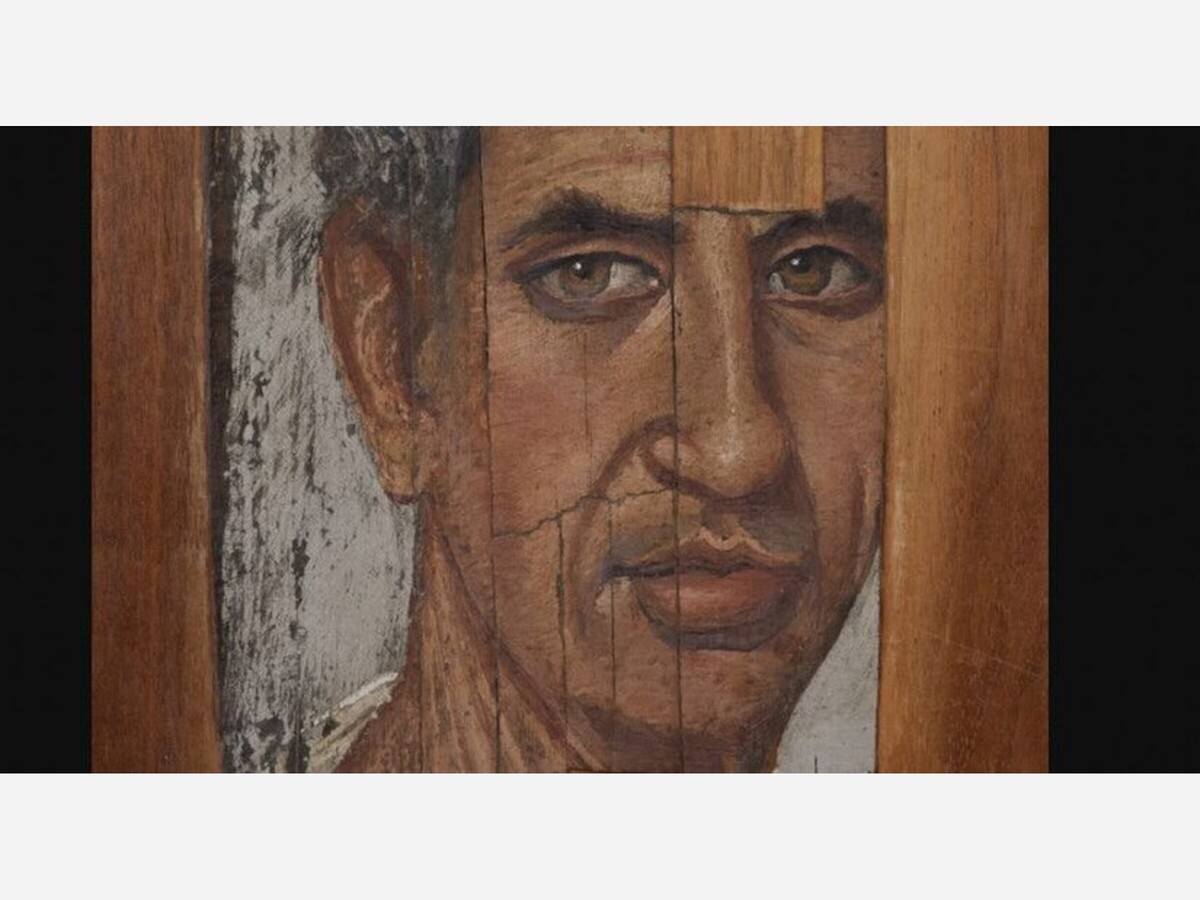
Roman Egyptian mummy auctioned in New York
A rare mummy portrait from Roman Egypt was auctioned last week. This unique piece features a modern-looking man with hazel eyes and graying hair.
NEW YORK — A rare mummy portrait from Roman Egypt was sold last week. This unique piece features a modern-looking man with hazel eyes and graying hair.
According to a report from CNN, the Fayum portrait was painted in the first century A.D. and once belonged to Goucher College in Baltimore. It has also been displayed in major museums.
The artwork was created using hot beeswax and pigment on wood. It was expected to sell for $350,000 during Masters Week in New York.
Property from Goucher College
Mummy Portrait of a Man, Roman Egypt, Flavian Period, circa late 1st century A.D.painted on wood, his head turned to his right, and wearing a white chiton and white himation falling from the nape of the neck, his solemn face with full lower lip, long aquiline nose, translucent hazel eyes, bushy eyebrows, and furrowed brow, his wavy gray hair brushed forward above the foreheadencaustic on wood, probably sycamore12 3⁄4 by 6 in.; 32.5 by 15.4 cm
Reverend Dr. John F. Goucher (1845-1922), Pikesville, Maryland, acquired in 1895 while traveling to Egypt with the assistance of Émile Brugsch, Cairo and presented to Goucher College, Towson, Maryland shortly thereafter.
Exhibited in New York, Brooklyn Museum of Art, Pagan and Christian Egypt: Egyptian Art from the First to Tenth Century A.D., 23 January - 9 March 1941; Birmingham Museum of Art, The Archaic Smile, 1956;Detroit Institute of the Arts, Mummy Portraits from Roman Egypt, 22 March - 30 April 1967;New York, Metropolitan Museum of Art, Ancient Faces: Mummy Portraits from Roman Egypt, 15 February - 7 May 2000; Baltimore, Walters Art Museum, long-term loan, from 1950 - present (inv. nos. IL149.1950, IL 1990.28).
Sotheby’s recently sold a painting of a man from Roman-controlled Egypt in the first century CE that experts suggest represents the dawn of realistic portraiture 1,200 years before it appeared in Italy.
The image is part of a family of works known collectively as the Fayum Mummy Portraits, all of which were found during 19th century excavations at a site called Hawara in Egypt’s Fayum region.
The portraits were placed atop mummified remains like masks, and were painted with pigment mixed with melted beeswax on wooden panels. Over 900 have been found, and some have been auctioned.
This portrait of a dark-skinned senior with graying hair, piercing hazel eyes, and a large lower lip recently brought in $889,000 with fees. Though they were painted and entombed in Egypt, the subjects could be Romans, whose nobility could afford both mummification and portrait commissions.
The nose might give the man up as a Roman; the substantial bridge being a feature of the Italian race still today. Others are perhaps less obvious.
What unquestionably stands out is the true air of realism in the work—one gets the feeling all at once that the man truly appeared as he is portrayed.
“It invites you to want to know more about him and to feel his presence,” said Alexandra Olsman, a Sotheby’s specialist in ancient sculpture and works of art.
Roman domination of Egypt came only after Macedonian domination of Egypt under the Ptolemaic dynasty. Whatever skin/eye color and features the ancient Egyptian race had, the population in the major cities would have long been altered by intermarrying with northern Mediterraneans.
It’s not known whether the sitters were painted in death or life, or some state in between of infirmity. Olsman told CNN that with the sincere connection through the eyes, it would seem unlikely to be the artist’s interpretation of a dead man.
Sotheby’s has sold over a dozen Fayum mummy paintings over the years, and this one along with another featuring a curly-headed, younger man, commanded the highest bids.



Patchy rain nearby, with a high of 91 and low of 73 degrees. Patchy rain nearby during the morning, overcast for the afternoon and evening, clear overnight.