56° and Clear



Image
Blackout fears debated at 4th Circuit hearing on proposed Maryland power line
Appellate judges also discuss the possibility of sending the case to the Maryland Supreme Court

The U.S. 4th Circuit Court of Appeals in Richmond, Virginia. (Photo by Sarah Vogelsong/Virginia Mercury)
The dispute over a power transmission line planned for Central Maryland reached a federal appeals court in Richmond, where attorneys sparred Tuesday over survey work that is already underway.
Attorneys for numerous landowners in the path of the 67-mile power line argued to a panel of the U.S. 4th Circuit Court of Appeals that the land surveys being performed by PSEG Renewable Transsmission are an unauthorized use of eminent domain.
But PSEG’s attorneys argued that, if the company cannot continue completing surveys over landowners’ objections, the Maryland permitting process for the power line would become “completely unworkable.”
At issue was whether PSEG can use its right to eminent domain to conduct wildlife studies, wetland and forest delineations and other survey work before it has received a construction certificate from the Maryland Public Service Commission.
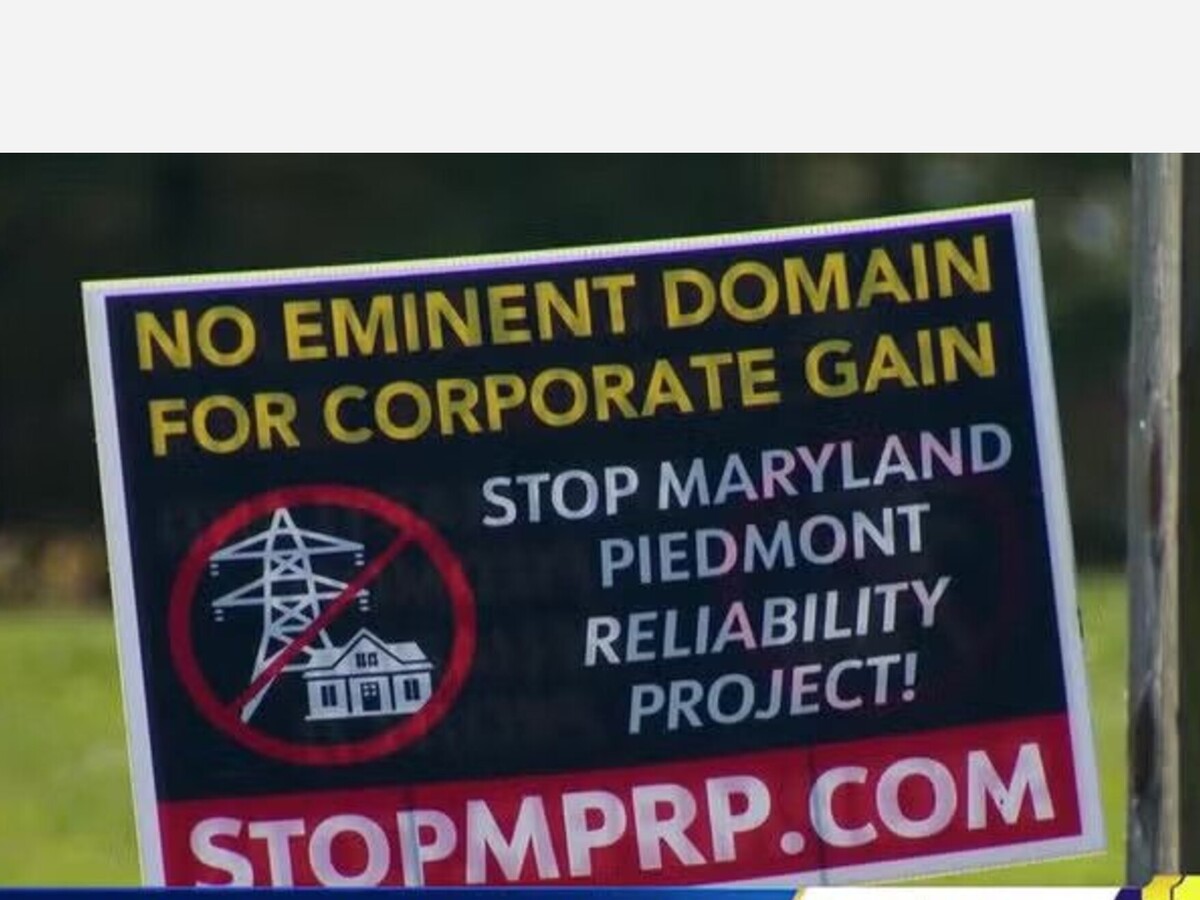
The project, called the Maryland Piedmont Reliability Project, ignited a firestorm of criticism from local landowners when it was announced in the summer of 2024, largely because the line would run through natural areas and farmland previously untouched by development.
But it came at the behest of PJM Interconnection, the electric grid operator serving Maryland, which commissioned a host of transmission projects to meet increased electricity demands, primarily from AI data centers at a time when fossil fuel power plants are being retired. PJM has warned of blackouts and other challenges if the power line isn’t built, and set a deadline of June 2027 for the line to come online.
The warnings from the grid operator seemed to loom large for Judge J. Harvie Wilkinson III, one of the three judges hearing the case, who questioned attorneys about the predictions several times Tuesday.
“We’re not taking the developer’s word for it…. That wouldn’t be all that persuasive,” Wilkinson said. “But here you’ve got expert opinions — a process authorized by Congress — and you’ve got people quite outside the developer’s orbit who are saying: ‘This is important. This is necessary.’”
Though eminent domain is among the most “disagreeable” powers used by the government, Wilkinson said, sometimes it is necessary. And when courts are deciding whether to issue a preliminary injunction, one of the requirements is that it be in the public interest.
“I’m concerned, practically, about: If this thing falls apart due to the delays, whether we are not lending our hand to eventual blackouts in Maryland,” Wilkinson said.
Attorneys for the landowners fired back, arguing that the PSEG project is one among several suggested by PJM to address blackout concerns, and that the grid operator is already preparing for the power line to be delayed, including by keeping the Brandon Shores coal plant and H.A. Wagner oil plant in Maryland running beyond planned closure dates.
“There are contingency plans that are in place right now to make sure that the predictions of brownouts and blackouts and all these terrible things happening in Maryland don’t actually happen,” said Harris Eisenstein, an attorney for the approximately 60 landowners who brought the appeal to the 4th Circuit.
The appellate court is being asked to decide whether the surveys can continue, after the U.S. District Court in Baltimore determined that the surveys could take place — and issued an injunction to ensure that they occur. But the appeals court could go an altogether different route.
I'm concerned, practically, about if this thing falls apart due to the delays, whether we are not lending our hand to eventual blackouts in Maryland.
– U.S. Circuit Judge J. Harvie Wilkinson III, on worries that delaying the Maryland Piedmont Reliability Project could contribute to power shortages
During Tuesday’s proceedings, the judges toyed with sending, or certifying, the matter to the Maryland Supreme Court, because the case involves interpreting Maryland’s laws on eminent domain.
“There’s an eerie guest at the core of this. It’s sort of like a central state issue. I’m not aware of our court ever certifying a question in a preliminary injunction posture. But do you have any objection to that?” Judge Julius N. Richardson asked Kurt Fischer, an attorney for PSEG.
Neither the landowners nor the power company objected to the idea during Tuesday’s hearing.
“As long as the preliminary junction remained in place, and we could continue performing the surveys,” Fischer said. “I can’t say that I’m afraid of what the Maryland Supreme Court might do. So I don’t want to say I would object to it. I think we are absolutely correct.”
But Wilkinson worried that certifying the case at this stage would be “unusual,” especially since it also involves significant questions about federal law — not just state law.
It’s federal regulators who oversee transmission planning, even though Maryland state law governs the use of eminent domain, Fischer said. PSEG has maintained that the line is necessary despite pushback from the landowners, who have cast doubt on the urgency for the line.
“The Public Service Commission establishes the alignment, where the line will go, what properties will be affected,” Fischer said. “But the federal government, through PJM and FERC, is responsible, on a regional 13-state basis, for determining the need for transmission facilities.”
The line currently sits before the PSC, which must decide whether to issue the certificate, and does not plan to make the call until at least February 2027 – rendering PJM’s deadline for the project impossible to meet.
The project’s legal saga began about one year ago, when PSEG first asked a federal judge to grant it permission to survey landowners’ properties amid significant objection from hundreds of landowners.
U.S. District Judge Adam B. Abelson sided with PSEG, authorizing the company to conduct any survey so long as it provides 24 hours notice to the impacted landowner. Abelson later authorized U.S. marshals to accompany surveyors to a handful of properties because of continued resistance.
Another dispute arose at the beginning of Maryland’s deer hunting season this fall. At a hearing in Baltimore, PSEG argued that hunting should be restricted during any days when surveying might occur on a particular property, because of concerns that surveyors could be caught in the crossfire.
But Abelson said that was too broad, and ruled that hunting could only be banned while surveyors were actively working on a particular property.



Sunny, with a high of 69 and low of 46 degrees. Sunny during the morning, clear for the afternoon and evening,